Peace, Power, Playfulness: Women in The Universe of Skawennati
Article extrait du catalogue Skawennati : Bienvenue à la maison des rêves (2025), publié par le Musée des beaux-arts du Canada. En vente à la Boutique du MBAC.
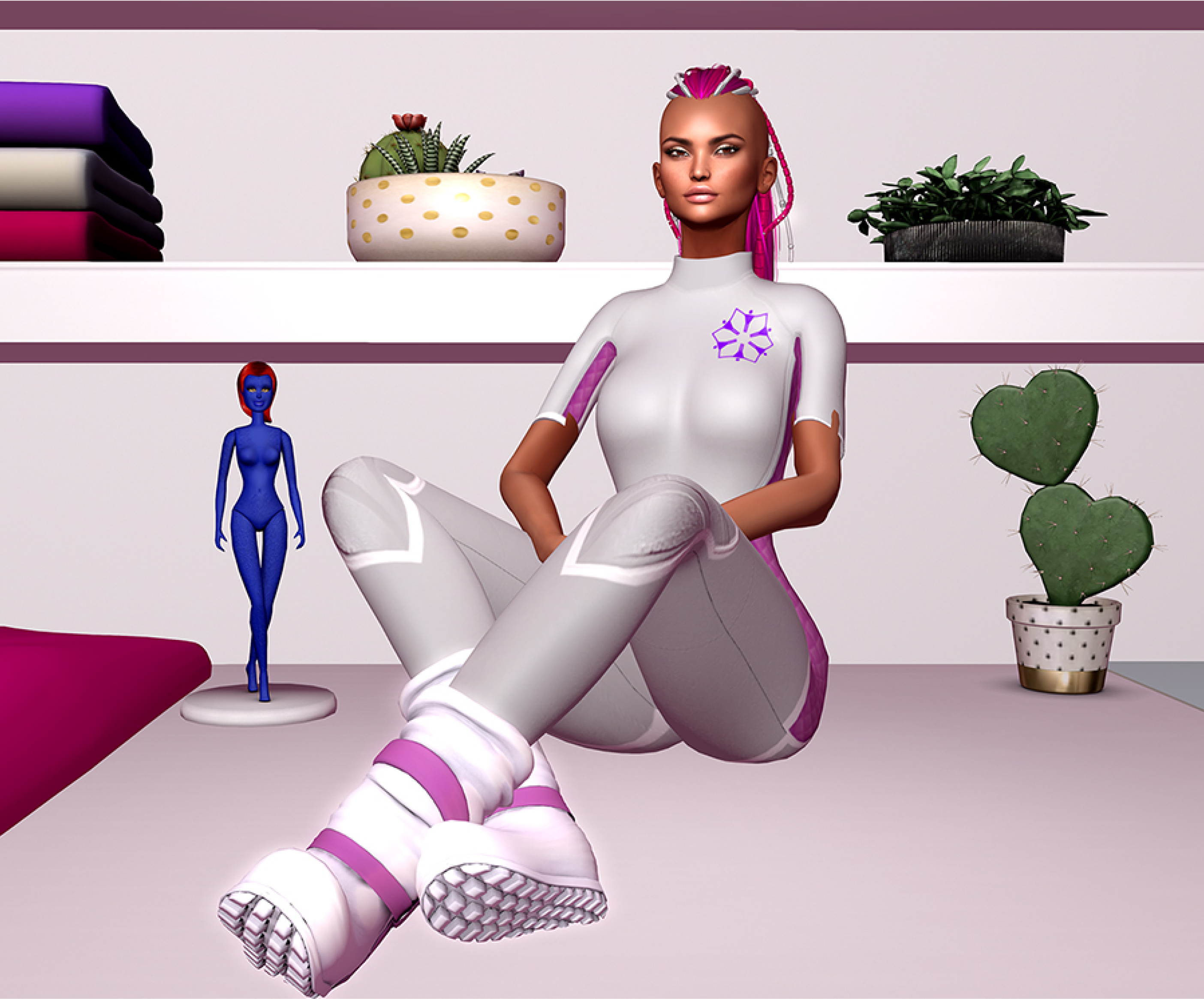
Over a career that spans three decades and counting, Skawennati, a multi-disciplinary artist in the physical world and a cyberpunk avatar named xox in the virtual world, uses her work as a vehicle towards a future that is Indigenous and thriving. As an urban Kanien'kehá:ka woman, her practice focuses on Indigenous futurism and Hotinonshón:ni cosmology and history. An overarching theme in her practice is also the prominence of strong, powerful women.
As a Kanien'kehá:ka woman myself, I can relate to these female figures – it was probably what drew me to her work more than anything. Interacting with Skawennati through the worlds she has imagined and the women she has brought to life allowed me to connect with my culture and history.1 This interaction also encouraged me to reach for my own future. Skawennati not only imagines but creates a thriving future within her work. It is something that has solidified from being strictly in the virtual world, through web-based works and machinimas, to becoming tangible works of sculpture and textiles.2
Completed in 2000, Imagining Indians in the 25th Century is the earliest artwork in this exhibition.3 This web-based piece takes inspiration from paper dolls, which children could cut out, along with various outfits, and mix-and- match to dress their figures. The figure in this work is Katsitsahawi Capozzo, a young woman who works as a web designer and, with her fuchsia t-shirt, her mixed Kanien'kehá:ka and Italian heritage, and her “kick-ass boots,” is not unlike Skawennati herself. Katsitsahawi also serves as an early template for xox.
Katsitsahawi’s adventures take her to different moments over the course of a millennium – moments that highlight important events in Indigenous history on Turtle Island. She embodies people from these historical moments, usually well-known Indigenous women, such as Pocahontas, Sacagawea and Kateri Tekakwitha, and keeps a journal for each era she travels to.
In her initial journal entry from 2000, Katsitsahawi describes to her dismay the current state of “Native affairs,” which runs at a “snail’s pace.” It is especially poignant that she feels this at the start of a new millennium, which should be a hopeful moment in history. She also outlines her hopes and dreams for Indigenous Peoples to thrive in the next millennium.
And she does indeed get the opportunity to see that thriving future for herself as she travels hundreds of years forward in time, finally arriving in the year 2490. Here, Katsitsahawi is an athlete competing at the Edmonton Olympic Games, and over 90 per cent of the athletes are of Indigenous descent.
In this future, Indigenous Peoples have reclaimed their land, their culture – and their power. Women, too, have regained their power.
We as Hotinonshón:ni people are traditionally a matrilineal society.4 Women traditionally played an important role in diplomacy. This is something that was ignored by European settlers as they were accustomed to dealing with men. Women were the caretakers of the land, of their families and of preserving and passing on the culture. It is also a role that, although altered, we continue to honour, increasingly reclaiming that power as we work towards rematriation of our culture. It is something that we can not only imagine but manifest in reality. This, including Indigenous Peoples’ reclamation of their land, their culture and their power, are themes that Skawennati carries out through her artistic practice.
Skawennati’s move towards crossing the virtual and physical thresholds began with the groundbreaking work TimeTravellerTM (2007–14), which she has described as the brother piece to Imagining Indians in the 25th Century. In this sci-fi love story, which is told as a nine-part machinima, the main protagonist, Hunter, visits similar points in history that Katsitsahawi visited.
The story begins with Hunter and his perspective as a twenty-second-century ironworker, hunter and warrior. His recreational journey into the past connects him with a young woman from the twenty-first century, Karahkwenhawi, whom he falls in love with. Across nine episodes Karahkwenhawi becomes more central, and we hear her voice and see her hopes and dreams unfold by the end. As a long-term project for the artist, it made sense to explore and expand on the world of TimeTravellerTM and the relevant sets and assets that were integral in the machinimas.
Skawennati credits curator and writer Jennifer Matotek for prompting her to delve into the first of several projects that have led to the virtual becoming physical. In the exhibition Realizing the Virtual (2015), the Dunlop Art Gallery was transformed into three sets taken from the world of TimeTravellerTM: Karahkwenhawi’s bedroom, Hunter’s apartment and the couples’ dreamhouse. The first object recreated was a giant dreamcatcher, which Skawennati commissioned from her cousin Kathleen Dearhouse. The feeling of being able to physically create an object that was formally only available virtually was nothing short of magical to Skawennati.5
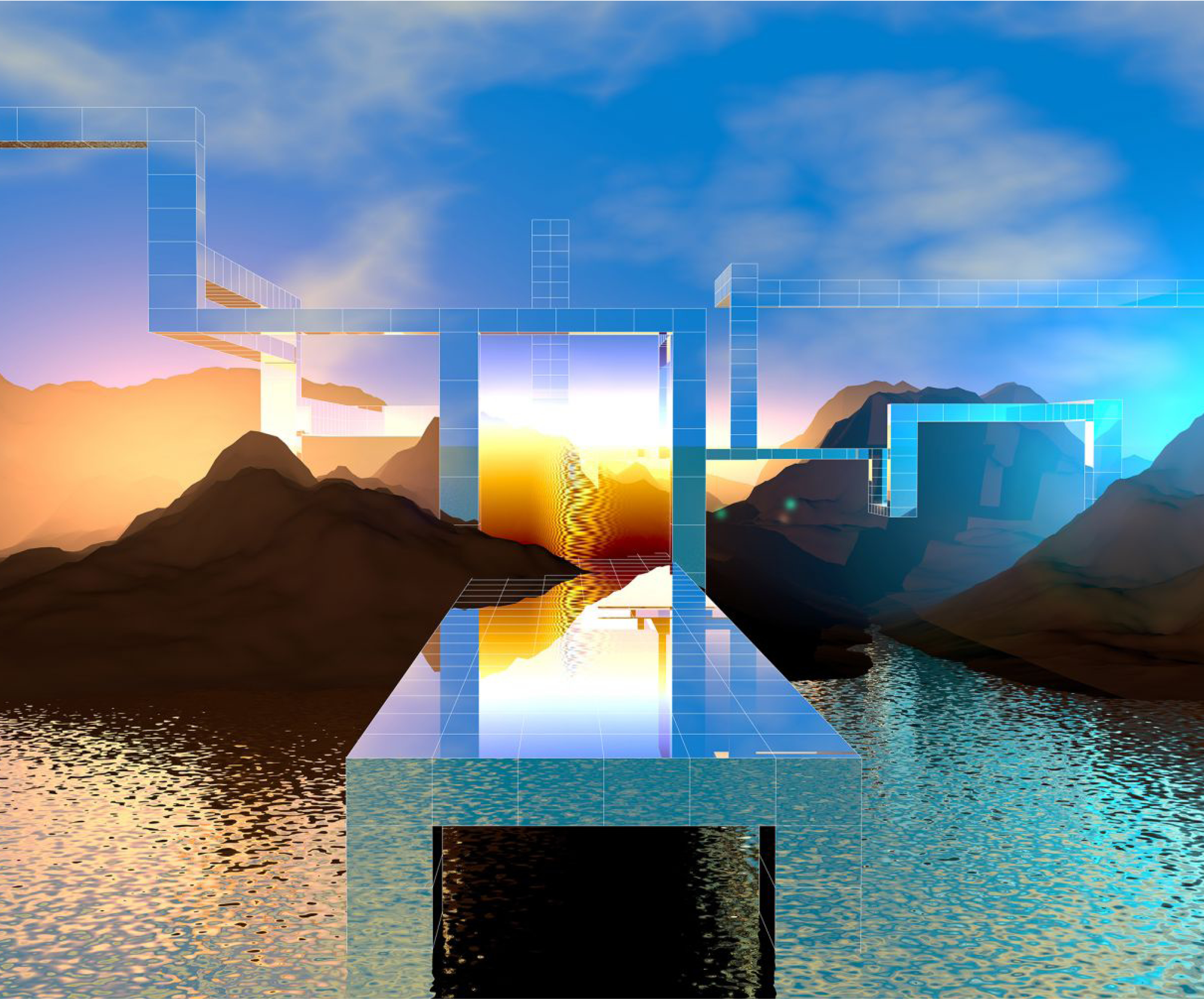
Teiakwanahstahsontéhrha’ | We Extend the Rafters (2017) was really the first work of Skawennati’s to fully be conceptualized in the physical realm. Created in response to a request to create an exhibition specifically for children, Skawennati had the opportunity to think beyond objects coming to life and rather envision a world coming to life.6 The work consists of three major components: The Peacemaker Returns, a machinima; Longhouse of the Future, an immersive, aluminum and LED-light structure; and Wampum Belts of the Future, five woven and beaded wampum belts. The latter Skawennati modelled from Hotinonshón:ni historical belts, such as the Kahswentha, or Two-Row wampum, and from their associated concepts, such as recording important diplomatic relationships and treaties.
The Peacemaker Returns is told through the lens of Iotetshèn:’en, an intrepid female Hotinonshón:ni space-travelling diplomat from the year 3025. She retells in brief our people’s story of Tekanawita and how our nations – Onödowá'ga:', Gayogo̱hó:nǫ', Onoñda'gegá', Onyota'á:ka and Kanien'kehá:ka – came together to form a confederacy and buried their weapons under a great white pine, a symbol that came to be known as the Tree of Peace.7
In this machinima, the governing aspects behind the Hotinonshón:ni Great Law are adopted universally on Earth but also beyond, as humans make contact with beings from other planets. This playfulness has a more serious undertone: we have to understand our past in order to move forward. As such, the story of Tekanawita contains valuable lessons for the present day.
In the machinima She Falls for Ages (2017), the Hotinonshón:ni creation tale is retold and reimagined (as our people have been doing since time immemorial!) – this time as alien skydwellers, whose Celestial Tree is an energy-producing being that is central to their world and way of life.8 The brave protagonist, Otsitsakáion – colloquially known and remembered as Skywoman – is the first woman, the first mother, the first person to give life on Mother Earth, on Turtle Island. The work also creates a link between the past and the future in a story that continues to be retold by our people. After making this machinima, Skawennati made and wore Otsitsakáion’s ceremonial outfit, once again crossing the threshold between virtual and physical.
On the Occasion of the Three Sisters Accompanying xox on Her Visit to the Queen (2022) is another work that depicts strong Indigenous women and bridges the virtual and physical. The four women are dressed for an audience with Queen Elizabeth II, and xox carries a new wampum belt, which Skawennati later wove with glass and shell beads. Three Sisters: Reclaiming Abundance (2023) and They Sustain Us (2024) are timely works, referencing our ancestors’ agricultural practices and scientific knowledge: that corn, beans and squash grow best together, which speaks to strength in unity. The representation of the Three Sisters also refers to the environmental degradation, trauma and disrespect that has been ongoing since colonization and since the Industrial Revolution, which goes hand in hand with the disrespect that is afforded to Indigenous women on this land. What better way to reclaim our powers and heal from that trauma and illness than to depict the Three Sisters as superheroes, as strong women with the superpowers of creation and strength.9
They have resisted war, colonization, corporate greed and insecticide. They can be considered as goddesses or warriors or both.
In talking about realizing the Three Sisters as real-life superheroes, Skawennati recounts:
So, when I was working on They Sustain Us, I had started looking back and seeing all these things that I had made, these physical objects. It seemed like the imaginary, virtual items that I had created in cyberspace – these intangible items – it seemed like they were coming to life and it made it feel like the future could be sooner. All my futures were so far in the future. The Peacemaker Returns takes place in 3025. But when I make these objects, it’s like I’m making the future happen now. So, I decided that in my next piece, I wanted the future to be in five minutes, you know, and I was like, “So we’re going to have the Three Sisters. We’re going to have the story of how they became superheroes and it’s going to play on these screens. And at the end, the Three Sisters in their superhero costumes are going to walk out of the screen in some way. Maybe there’s going to be a puff of smoke, I don’t know, but they’re going to walk out and they’re going to be there in the flesh and I want that to mean the future is now.”10
A recent work, Dollhouse Longhouse (2024) uses a single-channel projection of a machinima onto a fabricated, dollhouse-sized, longhouse structure. It playfully unifies the digital and the physical, the past and the future. The work features a lullaby in Kanien'kéha, sung by Skawennati. We also see references to other works, such as the Celestial Tree from She Falls for Ages. Here, the future is a place where we are fully immersed in our matrilineal way of life.
I have had the pleasure of knowing Skawennati for over a decade now and of experiencing her work for even longer. As a fellow Kanien'kehá:ka woman, I recognize myself in her work, and I hope that many other young women from our Nation and Kahnawà:ke will recognize themselves, too. Maybe in some way Skawennati’s work has helped to shape me and imagine me into reality: an Indigenous cultural worker seeking to empower our people, especially our women and girls. As a mother and auntie, this has especially become an integral part of who I am and why I do what I do. Like the avatar xox, Karahkwenhawi and Katsitsahawi, like Otsitsakáion and the Three Sisters, Skawennati’s multitude of alter-egos hold up a mirror to ourselves as something to strive for and to imagine and create our own, thriving reality.
Notes
1 Skawennati is from Kahnawà:ke Mohawk Territory (located south of Tiohtià:ke/Montreal) and is Turtle clan. Hotinonshón:ni also refers to Haudenosaunee as well as Iroquois. Kanien'kehá:ka is the word used for Mohawk in Kanien'kéha (the Mohawk language). It translates to “people of the flint.”
2 Machinimas are movies created/filmed in a virtual setting. Skawennati’s machinimas are created in the massively multiplayer online world Second Life.
3 Imagining Indians in the 25th Century can be accessed through: https://skawennati.com/legacy/ImaginingIndians/index.htm.
4 In this future, all Indigenous women who lost their Indian Status (as defined in the Indian Act) by marrying non-Indigenous men have regained their status. This includes their children and grandchildren – and down the line – until the majority of the population is again Indigenous, and we are once again sovereign of our own lands. The Indian Act is a Canadian law of Parliament, which defines who is a “Status Indian,” which lands are deemed to be Indigenous, and what the rights of Status Indians are. It has undergone changes over the years since it was first implemented in 1876.
5 Interview between Wahsontiio Cross and Skawennati, 24 October 2024.
6 Teiakwanahstahsontéhrha’ | We Extend the Rafters, Children’s Exhibition, 28 October 2017 to 27 January 2018 at Centre Vox, Montreal.
7 Onödowá'ga:' (“People of the Great Hill,” known as Seneca), Gayogo̱hó:nǫ' (“People of the Great Swamp,” Cayuga), Onoñda'gegá' (People of the Hills,” known as Onondaga), Onyota'á:ka (“People of the Standing Stone,” known as Oneida). The Skarù:rę? (“People of the Shirt,” known as Tuscarora) were accepted as the sixth nation in the confederacy in 1722. The Tree of Peace literally and symbolically illustrates our nations becoming stronger in unity. See: “Symbols,” Haudenosaunee Confederacy website, https://www.haudenosauneeconfederacy.com/symbols/ (accessed 17 November 2024).
8 The Celestial Tree is often found in Hotinonshón:ni material culture, most notably on beadwork. It is a symbol that refers to our creation story; a reminder of the place in Karonhiake (the sky world), the journey made by Skywoman to the turtle’s back.
9 Skawennati, “Three Sisters: Reclaiming Abundance,” Skawennati.com, https://skawennati.com/projects/three-sisters-reclaiming-abundance/ (accessed 15 November 2024).
10 Interview between Wahsontiio Cross and Skawennati, 24 October 2024.