Latinx Identity Uprooted: Tracing Destierro in the Comic Biography: Who Is Ana Mendieta?
Text from Inks Journal special issue "Inked Latinidades: Latinx/e Voices and Narrative Viñetas" vol 9, Issue 3, Fall 2025. Edited by Nora Lucía Serrano. Published by the Ohio State University Press.
Jennifer Caroccio Maldonado is Assistant Professor of English at Baruch College, CUNY. Her research focuses on Latinx literature and culture, graphic narratives, and women of colour feminist theory. Her current book project examines Latinx graphic memoirs and comic biographies as forms of counter-history that challenge dominant narratives about Latinx communities. Her writing has appeared in The Routledge Companion to Gender and Sexuality in Comic Book Studies and other academic publications. She holds a PhD in American Studies from Rutgers University–Newark. jennifercaroccio.com
Mendieta’s traces today are to be found not in the art institutions . . . but on the margins, in the alternative spaces where her memory has been passed down.
Iraida H. López, Impossible Returns: Narratives of the Cuban Diaspora1
INTRODUCTION
Comics, once an unconventional form for the biography genre, have steadily gained recognition as a legitimate source for profiling both prominent and lesser-known public figures. Yet, where are the comic biographies of Latinx individuals? One notable example is Who Is Ana Mendieta? (2011), in which Christine Redfern and Caro Caron commemorate the life and art of Cuban American artist Ana Mendieta.3 In the 1970s and 1980s, Mendieta used her body, ephemera, twigs, flowers, fire, and sand, as well as the land itself, to create art that challenged traditional aesthetic and cultural boundaries. Redfern and Caron—French-Canadian artists who are not Latinx—first published their comic biography in French as Qui Est Ana Mendieta?4 However, their focus on a Latina immigrant artist places Who Is Ana Mendieta? within the broader context of Latinx cultural historiography in comics. I build on the translingual nature of their graphic work to argue that the comic reframes Mendieta’s immigrant experience not through the concept of “exile,” but through the Spanish term “destierro,”5 which is conjugated from the Spanish verb “desterrar,” meaning “to be uprooted or banished.”
Destierro is a better term (left intentionally untranslated) than the typically used "exile," which would more accurately be translated in Spanish as "exilio." According to David Brodsky, "desterrar" can be translated as "to cover with earth," "to demolish," or "to land."6 José Luis Cifuentes Honrubia and Susana Rodriguez Rosique define it more directly as "to banish."7 I also find Michael Ugarte's translation of "desterrar," "to be 'unearthed,'" particularly helpful for my argument.8 Lastly, Cuban American writer Achy Obejas provides a powerful distinction in Days of Awe: "In English, destierro always converts to exile. But it is not quite the same thing. Exile is exilio, a state of asylum. But destierro is something else entirely: It's banishment, with all its accompanying and impotent anguish. Literally, it means to be uprooted, to be violently torn from the earth."9 In this article, I trace how Caron braids the imagery of burial and re-rooting, central to Mendieta's art, into the visual and narrative structure of the comic biography.
Before I begin my analysis of the burial and re-rooting imagery in Who Is Ana Mendieta?, I want to first look at why Redfern and Caron undertook this project. In their section titled "A Note to Readers," which follows the graphic narrative, Redfern writes: "Many people seem to want to ignore Ana Mendieta's life and even more so the circumstances of her death."10 The official story is that in 1985 Mendieta fell out of a window in New York City, though many feminist scholars and activists have long suspected that she was murdered by her husband, fellow artist Carl Andre. Despite these suspicions, he was never convicted of any crime. The comic biography offers a more intimate narration of Mendieta's artistic praxis that does not shy away from the circumstances of her life and death. In this retelling, Mendieta is drawn as the visual narrator, while Caron incorporates those very same everyday elements from Mendieta's work—twigs, flowers, fire, sand—to compose irregular panels and margins on the comic page that echo her artistic aesthetic. In this essay, I examine how the theme of longing for home in Who Is Ana Mendieta? both remembers and memorializes Mendieta's life and work through narratological devices such as focalization, braiding, and the use of the gutter.
Ana Mendieta immigrated to the United States from Cuba as a child in 1961 via Operation Peter Pan, following the revolution led by Fidel Castro two years prior. She would become a prolific visual and performance artist, best known for her "Siluetas" series—a collection of photographed and videotaped performances in which she created silhouettes of herself (impressions) in sand, dirt, fire, stones, and flowers. The imagery of burial and re-rooting that characterizes these works is also woven throughout the pages of the comic biography.11 My article examines three aspects of the comic biography: the foregrounding of destierro as a central theme in Mendieta's art (see first section, "Traces of Destierro in the Comic"). I then connect destierro to the way in which Redfern and Caron emphasize this theme narratively and visually. They do this by rendering the biography from the first-person point of view, positioning Mendieta as the narrator of her own story (see second section, "Focalization and Braiding in Destierro"). Lastly, I highlight how Redfern and Caron invite readers to consider the various ways in which the artist sought to re-earth herself through artistic expression (see third section, "Re-rooted and Re-Membered in Public Space").
Mendieta's graphic narrative is constructed through her dual role as visual and verbal narrator. Frederick Luis Aldama, in Your Brain on Latino Comics, describes the function of multiple narrators as an oscillation that "affects the feel and the kinetic quality of the story" as it "acquires its own unique pendular rhythm, swinging between the visual narrator and the verbal narrator in ways that lull and surprise."12 In Who Is Ana Mendieta?, this narrative device creates an emotional immediacy: as the subject of the text, when Mendieta speaks directly to the readers, the narrative move impacts the emotional connection readers feel with the comic biography. This intimacy invites readers to engage deeply with her experience as an artist. In this context, we see Mendieta as an artist struggling to and ultimately succeeding in re-rooting herself in the wake of her forced expulsion from Cuba. Redfern and Caron meticulously dig through the archive of letters, films, interviews, newspaper clippings, and lectures in their attempt to recuperate Mendieta's artistic journey, which is catalogued in an "Annotated Bibliography" at the end of the book.13 What sets Who Is Ana Mendieta? apart from other biographies is the visibility of this recovery process. Through Caron's detailed drawings and illustrations and the integration of archival research, including previously published work, interviews, and papers, readers are made aware of the narrative choices involved in piecing together Mendieta's story. The comic medium lays bare the process of creating a life narrative, as well as telling it. I argue that Who Is Ana Mendieta? takes on a more intimate engagement with its subject, like other experimental biographies such as Lauren Redniss's Radioactive (2010), which tells the life of Marie Curie. As Candida Rifkind notes, Redniss blends "archival research, cultural history, and experiments in graphic biography."14 Rather than relying on a conventionally authoritative narrator, Redniss uses the comic form to "convey a sense of Curie's persona as much as the facts of her person."15 Redfern and Caron implement a similar method. Who Is Ana Mendieta? emphasizes the personal dimensions of Mendieta's life, offering a more intimate engagement with her story than traditional biography typically allows, rather than adhering to a strictly factual recounting.
TRACES OF DESTIERRO IN THE COMIC
Who Is Ana Mendieta? engages with multiple meanings of the word "trace." When reproducing Mendieta's artwork, Caron carefully traces, as in "to draw or to copy," many of the pieces. In doing so, the illustrator unearths the traces, as in "the vestiges," of Mendieta's life. It was well-known that Mendieta explored her Cuban and American identity through her art. However, the comic biography highlights how she supplanted the Eurocentric foundations of her formal training by incorporating an Afro-Latin American worldview. In her critical biography Where Is Ana Mendieta?, Jane Blocker refers to Mendieta's identity as occupying an "in-between" space, framing it through the concept of exile. Blocker argues: "By engaging the contradictions of identificatory practice … Mendieta occupies the discursive position of exile, and she uses this position to produce in us a sense of the uncanny."16 However, I depart from Blocker's interpretation by situating Mendieta's expulsion from Cuba within Benedict Anderson's Imagined Communities. Rather than viewing her condition as exile, I argue for destierro, a term that signifies forced uprooting and banishment from one "imagined political community" and displacement into another.17 The interstitial space of identity in Who Is Ana Mendieta? is mirrored formally through the use of the comic gutter, the space between panels, as a visual metaphor for dislocation and liminality. Understanding how individuals imagine their belonging to a nation, or an imagined community, helps us better comprehend how they internalize their uprooting. Within this framework, destierro becomes a political condition shaped by loss, memory, and the possibility of return. The comic biography invites readers to consider how Mendieta conceived of her own membership in Cuba in relation to her destierro and ongoing attempt to re-root herself. Redfern and Caron's graphic narrative thus traces Mendieta's artistic journey as one of reclamation, of both her Cuban identity and place, through self-representation and a recontextualization of her art within the comic form.
Mendieta's reclamation of her Cuban culture is best viewed through the concept of destierro, since the comic biography emphasizes her constant attempts to re-earth herself.18 Cultural theorists such as Isabel Alverez Borland and Yomaira Figueroa-Vásquez have used destierro as a conceptual framework for understanding the forced uprooting experienced by many Caribbean and Afro-descended people.19 In this context, destierro becomes integral to Mendieta's cultural citizenship as a Cuban American, allowing for a more nuanced reading of how identity, displacement, and belonging are negotiated in her work. My analysis builds on these scholars' notions of destierro by focusing on how destierro is portrayed in the comic through the techniques of braiding and focalization, which I develop further in the next section.
The close connection between art and narrative in experiences of expulsion is important for understanding how individuals reclaim their membership in their home culture. Alverez Borland, for example, examines how Cuban exile writers conceptualize post-1959 Cuban revolution history and navigate the tensions between their adopted and home cultures.20 Similarly, Who Is Ana Mendieta? illustrates how Mendieta used her art to establish and maintain her connection to Cuba, a theme made visible through Redfern and Caron's representation of her life and work. In like manner, Figueroa-Vásquez's theoretical work in Decolonizing Diasporas, which examines literature by Afro-descended people in Equatorial New Guinea, further demonstrates the relevance of destierro in understanding diasporic resistance in Afro-Atlantic hispanophone literature.21
Who Is Ana Mendieta? demands that we view Mendieta's art through the Latin American concept of destierro, as opposed to the term exile found in other biographical accounts. Redfern and Caron employ the comic form to trace Mendieta's life story in the evolution of her art. Caron's illustrated Mendieta highlights the work she undertook to re-root herself in Cuban culture. Many of the panel sequences depict Mendieta partially or fully immersed in the soil, poignantly alluding to her "Siluetas" series.22 Through the lens of destierro, the comic emphasizes how Mendieta used art to symbolically re-root herself in response to her displacement. In one of the comic's epigraphs, this sentiment of expulsion is conveyed through Mendieta's own words:
"I have been carrying on a dialogue between the landscape and the female body. I believe this to be a direct result of my having been torn away from my homeland during my adolescence. I am overwhelmed by the feeling of my having been cast out of the womb. My art is the way I reestablish the bonds that tie me to the universe." 23 mmm
Mendieta's art, then, becomes a method to reestablish those broken bonds.24 If destierro is understood as being violently unearthed from one's homeland, Mendieta's art offers a practice of return, one that symbolically reclaims belonging and desire to re-earth oneself in one's homeland. Given the numerous ways in which the comic biography illustrates Mendieta burying herself in the earth, it becomes apparent that destierro more accurately renders Mendieta's experience of cultural upheaval and dislocation than the term exile.
Redfern and Caron also demonstrate how Mendieta's re-rooting parallels her rejection of dominant land art movements of the time, which were largely Western and male. While it might be tempting to describe Mendieta as an artist before her time, the comic situates her work as a direct response to the artistic and cultural conditions of the 1970s and 1980s. Moreover, as the comic notes, Mendieta's art and performances "sought to make a statement about violence, power, and indifference in society."25 Mendieta condemned the violence that other male artists committed toward nature and how they interacted with the earth. Caron's illustrations show this distinction. Mendieta is often drawn nude—she was often without clothes in her performances—demonstrating a freeness, calmness, and intentionality that she had with her body. Notably, in one striking full-page panel, Caron draws Mendieta with her eyes closed, face relaxed, hands open, palms upturned.26 In contrast to other land artists who seemed, in their anger, like they wanted to violently dominate or break the earth, Mendieta has an embodied relationship to the earth that is marked by balance, reciprocity, and calmness. Her art did not seek power over the land, but rather to reconnect with it, thereby visually enacting the process of re-rooting that is central to destierro.
FOCALIZATION AND BRAIDING IN DESTIERRO
I contend that the recurring imagery and panels throughout Who Is Ana Mendieta? are a form of braiding, which is crucial to how the comic biography grapples with the layered complexities of Mendieta's dispossession, both in her forced removal from Cuba and the violence committed toward women. According to Thierry Groensteen in The System of Comics, braiding is the reading of a comic beyond linearity that connects nonconsecutive panels, or parts of panels, to others throughout the comic and in doing so "is not that of the strip nor that of the chain, but that of the network."27In this context, braiding becomes "particularly pertinent to an analysis of focalization," as theorized by Silke Horstkotte and Nancy Pedri in their article "Focalization in Graphic Narrative."28 For them, the term focalization is "the filtering of a story through a consciousness prior to and/or embedded within its narratorial mediation."29 I use focalization and braiding in my analysis of Mendieta's longing for home as depicted in the comic biography.
Redfern and Caron set up Mendieta's longing as a central theme that permeates both the narrative structure of the comic and the physical (geographical) places that inhabit Mendieta's art. Many of the one-panel pages in Who Is Ana Mendieta? are constructed as a collage of images that break from the linear time of traditional biographies. Unlike in a solely text-based medium, the image–text relationships communicate to the reader how multiple individuals and narratives intersect over time in any given instance. This layered temporality is evident early on in the graphic narrative when Mendieta is depicted as a young, scared twelve-year-old who was recently uprooted from Cuba. This image initiates the narrative of reclamation and cultural connection that unfolds throughout the biography. Who Is Ana Mendieta? presents perspective through both interior events (narrated by Mendieta) and exterior events (informed by history and politics) through focalization. One instance of this dual focalization, of overlapping interior and exterior narratives, appears in the depiction of Mendieta and her sister clinging to one another in fear at the beginning of the biographical sketch.30 This moment operates both as a subjective emotional memory and as part of the broader sociopolitical narrative of forced migration. The reader must navigate the visual complexities of the full-page frame, which Will Eisner calls the "super panel."31 According to Eisner, the super panel "serves as a containment without perimeter. It is best employed for parallel narratives."32 All at once, the comic biography is immersed in synchronous narratives of personal loss and geopolitical upheaval through the eyes of a child who, amid the individual trauma of political upheaval, has just emigrated from their home country to another, unknown and hostile.
The use of the super panel in Who Is Ana Mendieta? conveys not only temporal and narrative layering but also the metaphorical spaces inhabited by Mendieta. As Eisner explains, the super panel can evoke "the fluidity of action and amorphous quality of the setting," which in turn creates the effect of requiring the page to be "read as a single panel."33 Redfern and Caron's page layout demonstrates how, once in the new country, the sisters' racialization changes—the amorphous nature of the comic form mimics the amorphous nature of race.34 Mendieta, as a girl newly arrived in the United States, could not fully comprehend this racial reclassification at the time, one that defines her experience of destierro. Given that she would not return to Cuba for another nineteen years, the super panel is a pivotal page to mark her state of destierro. In the meantime, Mendieta becomes "suddenly marked."35 The comic underscores this moment through the visual and textual cues in which xenophobic and racist remarks highlight how Mendieta's whiteness within a Cuban context fails to translate into her new surroundings. This dissonance between how she is seen and how she sees herself further intensifies her sense of uprootedness, reinforcing destierro as both a spatial and a racial condition.
The new ground in which the Cuban American artist finds herself becomes metaphorically fertile in Who Is Ana Mendieta? as the comic reframes her diasporic subjectivity, identifying her not only as a victim of displacement but also as an active participant in the process of up- and re-rooting. Throughout the comic biography, the reader encounters the many ways in which Mendieta works to reconnect with the earth herself, sometimes by literally burying herself in the earth. Her reverence for the land, expressed in her later artistic trajectory spent in the soil, becomes fundamental to both her artistic identity and the foundational visual storytelling of this graphic narrative. In this context, the soil is the medium and metaphor in which Mendieta reestablishes the link between land and soul. Caron's drawings then become the medium to reproduce Mendieta's "Siluetas" series, created over several years, to visually converse across the comic's page. The visual braiding of root, land, and natural elements carries connotations of the ground, or of being grounded, and situates Mendieta's body in direct relation to the land.
Braiding extends the comic biography temporally and spatially in a way that allows for the reader to comprehend complex themes of destierro that might otherwise go unnoticed. Figueroa-Vásquez argues for "imagining destierro as a palimpsest of centuries of overlapping histories, lived experiences, ties to land and land-based practices, and multiple movements (forced and voluntary migrations) by dispossessed peoples."36 In this sense, destierro itself can be seen as a form of braiding—of temporalities, geographies, and affective experiences. Caron's drawings and page layouts reflect this approach. Caron immerses the reader in both the individual narrative of Mendieta as a young art student and her larger historical context. The open structure allows for dynamic reader engagement. For example, the reader can move around the page, engage intimately with the vulnerable body of Mendieta, indulge in voyeurism along with the audience in a particular scene, or take a step back and make their own assessment of the situation like one of the art commentators drawn in the story. As the focalization shifts across perspectives, times, and spaces, Who Is Ana Mendieta? reveals biography as not only a simple retelling of an individual's life, but as a larger, complicated production. Focalization aids how the comic articulates destierro. According to Figueroa-Vásquez, destierro "allows us to be faithful witnesses to the layers and forms of being forcibly ripped from the land while also seeing the resurgence of the land-based practices and resistance to dispossession."36 While Mendieta is the focus, her art and life make sense within the braiding of the panels and perspectives, aiding the reader in shifting fluidly from the micro to the macro stories and details, offering them the ability to do so at their own pace.
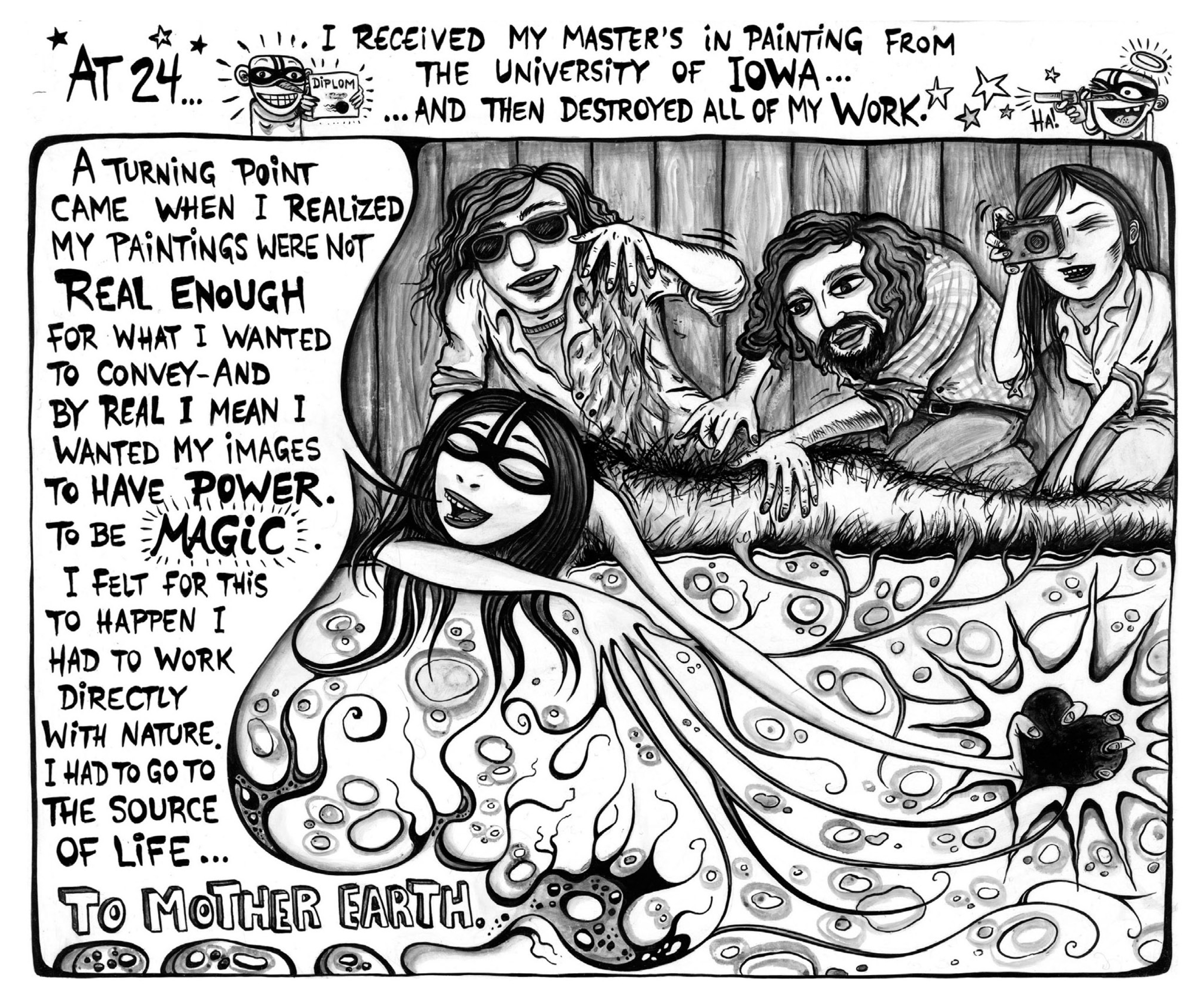
One of the visual devices that Redfern and Caron utilize to explore Mendieta's complex Latinx identity is the iconographic metaphor of good and evil, represented by the familiar trope of the angel and the devil perched on one's shoulders. In an early panel, the reader encounters Mendieta sitting with her knees close to her chest and her arms folded over her legs, a posture evoking vulnerability and introspection. The artist's advancement to adulthood is illustrated through a cartoonish depiction of a young girl with an oversized head, seated underneath a scale. On one side of her is a masked angel and the word "artist," while on the other side a devil holds a gun with the word "criminal" under it.38 This visual dichotomy illustrates a moral and existential crossroads, emphasizing the choices the artist must make amidst the pressures of being a racialized immigrant. As Blocker reasons, "By virtue of her identity and her politics, she exposed and troubled the assumptions that lie hidden behind strict dichotomies like male/female, earth/body."39 Caron illustrates this dichotomy, and in doing so resists placing Mendieta in it. In the next panel, Mendieta is shown wearing a mask like that of the angel, indicating her choice of the "artist" identity. She will wear the mask for the next several pages of the narrative. The repetition of the mask functions as a form of "iconic repetition," which Horstkotte and Pedri describe as a significant technique for the reader when a specific visual repeats throughout the narrative.40 The repetition emphasizes the eventual removal of the mask, which will signify another identity shift within Mendieta's story.
Who Is Ana Mendieta? presents three distinct temporal layers within its narrative structure: Mendieta's original artwork from 1973, her narratorial voice situated in the present moment of the reader's experience, and the publication moment of the comic in 2011. One scene that illustrates this multitemporal layering, emblematic of what Figueroa-Vásquez describes as the palimpsest structure of destierro,41 depicts Mendieta's senior art thesis performance at the University of Iowa. Caron illustrates Mendieta bent over a table with her pants down while spectators gawk. Redfern and Caron position this scene at the top of the page.42 In the middle of the page, the perspective changes. The reader now encounters Mendieta's face up close, as she narrates her reasoning for her performance: "My sister was beaten by her husband and another student was raped and murdered on my campus."43 This insertion of Mendieta's own voice disrupts the presumed objectivity of traditional biography, privileging her subjective interpretation and activism. At the bottom right corner of the page, the panel takes the shape of a circle, and within it the reader sees Mendieta lifted up by a larger skeletal hand and taken through an open window. The left side of the page features onlookers and various characters commenting on her performance piece.44 In this scene, the reader learns about how Mendieta's performance series critiqued a sexual assault that had taken place on campus. The comic breaks the façade of objectivity in the biographic genre by using Mendieta's own words to narrate the scene. Moreover, the focalization shifts, permitting Mendieta to speak directly to the reader. The comic also provides an additional layer of metacommentary on the larger cultural encapsulation of gratuitous depictions of sexual violence in entertainment in the form of TV producer Dick Wolf (creator of the many Law and Order series). He boasts that he could repackage this scene and make it "sexier" for the public.45
The graphic sequence ends with a giant skeletal hand swooping Mendieta up.46 Like Mendieta's rejection of Western, male land art mentioned earlier, her departure from white feminism coincides in the narrative with the skeleton whisking her from the audience and her performance. Mendieta removes her mask.47 In this pivotal scene the reader processes this variation, the removal of the mask, through focalization, not narration, which creates "a citation effect."48 The character of Mendieta narrates her departure to the reader, while the scene's focalization uses repetition and variation of imagery to engage the reader's cognitive process, prompting the question: what is the significance of the mask's removal?
Masking—and more importantly, unmasking—hold significant value in both Caribbean carnival culture and the comic book superhero genre. As Gerard Aching explains in Masking and Power, wearing a mask during carnival was a "visible means of challenging" power through "highly charged and complex modes of subversive communication."49 Caron weaves Mendieta's Caribbean heritage into the comic biography via this visual from carnival imagery.50 When Mendieta is seen removing her mask, she looks directly at the reader, breaking the fourth wall.51 Although a subtle gesture by Mendieta as the "visual narrator," the act of unmasking carries significant narrative emphasis.52 As Diana Adesola Mafe notes, "Comic book heroes in general tend to be physically idealized and inherently supernatural." Thus, even when a comic character masks (or unmasks), the comic artist remains rooted in the established comic tradition, despite the character's deviation from the traditional archetype.53 Mendieta may not be a traditional superhero, but the mask she wears still holds significant power.
RE-ROOTED AND RE-MEMBERED IN PUBLIC SPACE
I now consider how Caron's illustrations transform Mendieta from a formally trained US artist into a Cuban/Caribbean artist who reclaims public space. The comic biography depicts Mendieta's art as representing a form of Latinx cultural citizenship.54 Caron traces Mendieta outside the Lowe Art Museum in Miami, dressed as one of her "Rupestrian Sculptures."55 In dressing as one of her artworks outside the museum, Mendieta refuses and resists erasure from public spaces like the museum itself. Caron's illustrations do not direct the reader's attention to what, or in this case, who is in the museum—such as Carl Andre, the minimalist artist who was married to Mendieta and who was later acquitted of her murder. Instead, the images bring attention to who is outside it.
Mendieta's "Rupestrian Sculptures" are depicted without a clean line separating the panels, as compared to the page that narrates the police investigation immediately following her death, which does.56 Instead, the gutter is surrounded by dirt and roots.57 Through the convention of the comic page, Caron's illustrations take the image–text and re-root Mendieta's art and writing as one. The practice of reading comics requires readers to understand the significance of the "empty interstices that separate the pages."58 But Caron shows that these spaces are not empty, just as Chicana feminist writer Gloria Anzaldúa theorizes how los intersticios (the interstices) are "the spaces between different worlds" and how they are paralyzing, an in-between space where "the woman of color does not feel safe" because she is "caught between los intersticios."59 So too are the metaphorical spaces that Mendieta inhabits between Cuban and American identities as manifested in the physical interstices on the page. Mendieta's comic biography, as a part of the broader genre of Latinx graphic life writing, shows how the gutter can mimic or represent abstract ideas, such as the interstice or feeling emoted on the comics page. The comic biography takes Mendieta's marginalized voice and challenges the risk of forgetting. It is the interstitial space of the comic page as represented in the gutter that, I argue, visually represents los intersticios that define Mendieta's life and art.
Like los intersticios, the comic depicts how Mendieta's art occupied a liminal space that was also a space of "brownness," to borrow from José Esteban Muñoz.60 Mendieta traveled to Mexico to research various Mexican and Indigenous artistic practices. There, her artistic transformation begins.61 Caron's drawings transport the brown femininity and sensuality of Mendieta's work onto the comic page, and make it clear how Mendieta's art often stood in contrast to the bareness and starkness of minimalism—which was devoid of any symbolism and relied on basic geometric shapes. I argue that, by highlighting this contrast, Redfern and Caron are condemning Andre, who was a minimalist artist. Who Is Ana Mendieta? therefore places the artist's personal history within the political context of what Muñoz describes as a "cosmology that responds cogently to precarious histories of singular and multiple dispossessions … like the histories of violence against women and the imperial subjection of Caribbean people."62 Caron's drawings capture the "deeply symbolic indention in the world around her."63 Moreover, the comic presents Mendieta's cosmology through the depiction of destierro so that can we make sense of Mendieta's "poetics of dispossession."64 There are generative possibilities in Who Is Ana Mendieta? when we examine the traces of the desire to return through re-rooting as symbolized in the drawings of soil, blood, rocks, and flowers.
Caron braids roots and burial imagery throughout the comic to foreground that return. The comic biography places Mendieta's feeling of "being cast out" alongside the ever-present urge to go back, which I argue fits "the ontological force of brownness as a mode of particularity in multiplicity."65 Mendieta's artistic transformation in the graphic narrative centers on the symbolism of home and homeland in the development of her cultural citizenship. Her communion with the earth—both within and beyond the panels—mirrors her longing to return home and re-root herself. Mendieta, as verbal narrator, reflects in the comic biography: "As my voice grew stronger, my work became more intimately connected to the land."66 She lies nude, eyes closed, buried in the ground. Above her appear the roots of a great tree and around her are images from her "Siluetas" series.67 The circle on her upper right-hand side shows a silhouette covered in earth from her "Island, 1981" piece.68 It resembles Mendieta's actual artwork, Untitled, Incantation Olokun-Yemayá.69 The work with the earth and water and her choice of titles, like Olokun and Yemayá, reference an Afro-Cuban tradition,70 though it is unclear if Mendieta identified as Afro-Cuban herself.71 Who Is Ana Mendieta? explicitly portrays Mendieta's entanglement with Afro-Cuban culture by encapsulating her art in Indigenous and African iconography.72 Via the mode of visual juxtaposition that the comic form is known for, this comic biography visually motivates the reader to think about how Mendieta navigated cultural shifts, sometimes precariously, and to question how successful Mendieta was in mediating aspects of her Cuban identity. The comic biography connects Mendieta's work with her longing for home by juxtaposing the authors' research on Mendieta's life with the deep emotional intensity of her destierro. This is evidenced in the Annotated Bibliography, where the reader can find a catalogue of Mendieta's artwork that appears in the book.73
Mendieta's reminiscences of her cultural and artistic journey appear throughout the comic biography in the form of her words and art. Redfern and Caron illustrate the process of how Mendieta's art was exhibited and received. Iraida H. López (in the epigraph to this article) described her art as being found in unusual places: "Mendieta's traces today are to be found not in the art institutions … but on the margins, in the alternative spaces where her memory has been passed down." 71 Who Is Ana Mendieta? functions in the Latinx comics tradition that recuperates the marginalized subject. Individuals who were relegated to the margins of history are moved to the center. I argue that the comic form is integral to this recuperation, because the gutter is an interstitial space that allows us to see how those margins take form on the page, physically, thus allowing us to see it culturally in the narrative as well. For instance, consider the final scene of the graphic narrative, depicted in a panel that glimpses at Mendieta's traces. The scene is set at the gallery where Andre and art critics discuss moving on after his acquittal in the murder trial.75 Outside the gallery, Caron draws protestors from the Women's Action Coalition (WAC) and Guerilla Girls using direct action to address Mendieta's murder.76 The comic biography depicts the action happening inside and outside the gallery simultaneously, while also showing how the social actors move from the margins to the center of the narrative.
Caron's depiction of nonsanctioned protests attests to the alternative spaces that are imbued with Mendieta's memory. The protestors' faces are angry as they encroach on the sanctuary of the gallery space centered in the panel, making it feel claustrophobic. The comic page reflects the social change depicted: moving Mendieta from the margins to the center. Ending the graphic narrative here lights an emotional spark in the reader. As Aldama observes, because the visuals of the Latinx comic "arouse certain subcortical emotional responses," they can cause us to become "overwhelmed to such a degree that our body acts of its own accord."77 Women artists and activists still feel the traces of Mendieta's death and absence in the mainstream art establishment.
Destierro threads throughout the physical places where Mendieta forms her art in the comic. We see the artist as a diasporic subject reject the Western canon, opting to explore Mexican art epistemologies instead, as in Mendieta's trips to Mexico.78 The metaphorical space of the page relies on visual cues that connect image–text to specific moments in Mendieta's personal history. In a three-panel layout, Caron draws Mendieta as visual narrator leaving her senior thesis project. She looks happy with her hands thrown in the air, a stark contrast to the previous panel in which Mendieta reenacted a rape scene to critique the violence happening to women on campus. In the next panel, the reader sees her take off her mask while sitting in the lap of a skeleton. Then she is naked, straddling the skeleton. In the third panel, Mendieta lies on the ground with flowers around her as her mentor, Hans Breder, and the skeleton take photos. Mendieta as verbal narrator says: "We traveled to Mexico where it was easier for me to make art that communed with the bones of the buried past."79 The comic shows Mendieta's active role in her own education. After studying in Mexico, Mendieta would later return to Cuba. The skeleton occupies the metaphorical space of the narrative as a visual representation of the bones of the buried past.
Burying the bones symbolizes Mendieta's attempt at re-rootedness. The comic presents Mendieta's destierro as a chance for artistic exchange. Although by the 1980s she began to exhibit her work globally, it was not until returning to Cuba that Mendieta finally re-rooted herself, as shown in the comic. In Mendieta's voice, the narration states: "As my sculptures disappear back into the earth, I too wanted to return to my origins." Caron illustrates Mendieta as a cocoon opening, one arm holding a chicken (which she used in many of her pieces), evoking the use of animal sacrifice in the Afro-Cuban tradition of Santeria.80 As she developed as an artist, her journey back home inhabited a space within her art and her praxis. Mendieta continues: "I went back to Cuba, as well as deepened my connections to the large expatriate population in Miami."81 Accordingly, the comic biography reveals that, driven by her destierro, Mendieta forged a space where other Latinx and Cuban artists could create and exchange their work.
CODA
Extending the legacy of the Cuban migration experience in comics are the recent graphic memoir Worm: A Cuban American Odyssey, by Edel Rodriguez, and the graphic novel Isla to Island, by Alexis Castellanos, both published in 2023. These books devote more pages to life in Cuba than Who Is Ana Mendieta?, where scenes from Cuba make only brief appearances, and in Cristy C. Road's graphic memoir Spit and Passion(2012), where Cuba appears even less.82 This shift underscores the diverse ways in which the diasporic experience is depicted in comics. Redfern and Caron's work on Mendieta precedes other more widely known comic biographies, such as John Lewis's March (2013) and the more recently published Latinx comic biography Basquiat, by Julian Voloj and Søren Mosdal (2019).83 While there is further research to be done on graphic memoirs, comic biographies, and comics specific to the Cuban American experience, my article situates Who Is Ana Mendieta? as an integral part of the rich tapestry of Latinx comics and comic biographies published over the past two decades. Through focalization and braiding, Redfern and Caron's comic biography depicts Mendieta's reclamation of her Cuban identity as it intertwines with the diasporic concept of destierro, which the comic biography makes clear. Through the constructed nature of seeing, Caron traces Mendieta's artwork for the reader to witness. Who Is Ana Mendieta? portrays an artist processing her feelings of being ripped from her homeland. Through the imagery of tree roots and piled soil, the comic biography shows how art was a way for Mendieta to revive her connection to Cuba. Ultimately, it is this biographical sketching of destierro and diasporic longing that makes Who Is Ana Mendieta? a significant contribution to the comic biography genre, and to Latinx comics.
NOTES
1. Research for this article was supported in part by a 2023 fellowship from The Faculty Fellowship Publication Program (FFPP), which was sponsored by City University of New York (CUNY). Epigraph: Iraida H. López, Impossible Returns: Narratives of the Cuban Diaspora (University of Florida Press, 2015), 91.
2. A few notable comic biographies of lesser-known historical figures are Isabel Quintero and Zeke Peña, Photographic: The Life of Graciela Iturbide (Getty, 2008); Julian Voloj and Claudia Ahlering, Ghetto Brother: Warrior to Peacemaker (NBM, 2015); Olivier Balez and Pierre Christin, Robert Moses: The Master Builder of New York City(Nobrow, 2018); Giuseppe Latanza and Francesco Matteuzzi, Hokusai: A Graphic Biography (Laurence King, 2021); and Elizabeth Colomba and Aurélie Levy, Queenie: Godmother of Harlem (Abrams, 2023).
3. Christine Redfern and Caro Caron, Who Is Ana Mendieta? (CUNY Feminist Press, 2011).
4. Christine Redfern and Caro Caron, Qui Est Ana Mendieta? (Les Éditions du Remue-Ménage, 2011).
5. I purposely do not italicize Spanish in my writing. While I will provide translations of words, as seen later in this article, I believe stylistically marking Spanish words reifies the othering of non-anglophone languages as a colonial project. Using Spanish words in English without drawing attention to difference is a diasporic rhetorical move in my writing.
6. David Brodsky, Spanish Verbs Made Simple(r) (University of Texas Press, 2005).
7. José Luis Cifuentes Honrubia and Susana Rodriguez Rosique, Spanish Word Formation and Lexical Creation (John Benjamins, 2011), p. 145, ebook.
8. Michael Ugarte, Shifting Ground: Spanish Civil War Exile Literature (Duke University Press, 1989), 10.
9. Achy Obejas, Days of Awe (Ballantine Books, 2002), 309.
10. Redfern and Caron, Who Is Ana Mendieta?, 39.
11. While the terms can be interchangeable, I opt for "comic biography" instead of "graphic biography" as a rhetorical strategy to resist the urge to make our field more legitimate. The term "comic" reestablishes the link between comic biographies and their predecessors, the comic strip and the comic book, which have continued to be seen as a lesser-than art form, or merely part of "low-brow" culture.
12. Frederick Aldama, Your Brain on Latino Comics (University of Texas Press, 2009), 100.
13. Redfern and Caron, Who Is Ana Mendieta?, 54.
14. Candida Rifkind, "The Elements of a Life: Lauren Redniss's Graphic Biography of Marie Curie," The Comics Grid: Journal of Comics Scholarship 10, no. 1 (2020): 2.
15. Rifkind, "Elements of a Life," 2.
16. Jane Blocker, Where Is Ana Mendieta? (Duke University Press, 1999), 73.
17. Benedict Anderson, Imagined Communities: Reflections on the Origin and Spread of Nationalism (Verso, 1991), 6.
18. I originally used the term "desterrado" in a previous work: see Jennifer Caroccio Maldonado, "Latinx Comix: Graphic Memoirs and Comic Biographies as Counter History" (PhD diss., Rutgers University-Graduate School-Newark, 2020), 46.
19. As I have developed my application of destierro to Mendieta's comic biography, I want to acknowledge Isabel Alverez Borland's usage in Cuban-American Literature of Exile: From Person to Persona (University of Virginia Press, 1998) and Yomaira Figueroa-Vásquez's theoretical work on destierro in Decolonizing Diasporas: Radical Mappings of Afro-Atlantic Literature (Northwestern University Press, 2020).
20. Alverez Borland, Cuban-American Literature of Exile, 17.
21. Figueroa-Vásquez, Decolonizing Diasporas, 93. In a different application, Figueroa-Vásquez applies the term destierro in Decolonizing Diasporas to an Afro-Caribbean subjectivity. Figueroa-Vásquez has advanced destierro as "the phenomenon of being ripped forcefully from the earth" and states "that destierro is a violent act that is likewise a site for resistance" (27). I have previously come to a similar conclusion on the use of destierro in lieu of exile, or exilio in Spanish.
22. I spend a considerable amount of time describing the panels in the comic for accessibility reasons. My goal is to convey the visuals as well as I can for the blind or visually impaired.
23. Ana Mendieta, as quoted in Redfern and Caron, Who Is Ana Mendieta?, 17.
24. Redfern and Caron, Who Is Ana Mendieta?, 17.
25. López, Impossible Returns, 91.
26. Redfern and Caron, Who Is Ana Mendieta?, 30.
27. Thierry Groensteen, The System of Comics, trans. Bart Beaty and Nick Nguyen (University Press of Mississippi, 2007), 146.
28. Silke Horstkotte and Nancy Pedri, "Focalization in Graphic Narrative," Narrative 19, no. 3 (2011): 330–57.
29. Horstkotte and Pedri, "Focalization in Graphic Narrative," 334.
30. Horstkotte and Pedri, "Focalization in Graphic Narrative," 330.
31. Will Eisner, Comics and Sequential Art (W. W. Norton, 2008), 65.
32. Eisner, Comics and Sequential Art, 82.
33. Eisner, Comics and Sequential Art, 71.
34. Redfern and Caron, Who Is Ana Mendieta?, 21.
35. Alverez Borland, Cuban-American Literature of Exile, 31.
36. Figueroa-Vásquez, Decolonizing Diasporas, 93.
37. Figueroa-Vásquez, Decolonizing Diasporas, 93.
38. Redfern and Caron, Who Is Ana Mendieta?, 22.
39. Blocker, Where Is Ana Mendieta?, 10.
40. Horstkotte and Pedri, "Focalization in Graphic Narrative," 337.
41. Figueroa-Vásquez, Decolonizing Diasporas, 93.
42. Mendieta's student art performance was centered on bringing attention to the rampant sexual violence on campus. In the comic's Annotated Bibliography, you can find references to the rape scene depicted in the graphic narrative. Redfern attributes the information to an article by Lucy Lippard, as well as Robert Katz' biography Naked by the Window. Redfern and Caron, Who Is Ana Mendieta?, 28 and 48.
43. Redfern and Caron, Who Is Ana Mendieta?, 28.
44. Redfern and Caron, Who Is Ana Mendieta?, 28.
45. Redfern and Caron, Who Is Ana Mendieta?, 28.
46. Redfern and Caron, Who Is Ana Mendieta?, 28.
47. Redfern and Caron, Who Is Ana Mendieta?, 29.
48. Horstkotte and Pedri, "Focalization in Graphic Narrative," 344.
49. Gerard Aching, Masking and Power: Carnival and Popular Culture in the Caribbean (University of Minnesota Press, 2002), 4.
50. Redfern and Caron, Who Is Ana Mendieta?, 22, 24, 26, and 28.
51. Redfern and Caron, Who Is Ana Mendieta?, 29.
52. Aldama, Your Brain on Latino Comics, 100.
53. Diana Adesola Mafe, "'We Don't Need Another Hero': Agent 355 as an Original Black Female Hero in Y: The Last Man," African American Review 48, no. 1/2 (2015): 36.
54. I am working from William Flores and Rina Benmayor's theorical formulation in their book Latino Cultural Citizenship, which they define as the resistance by Latinx people to their removal from public social life as they strive to be "recognized as active agents in society" (1–2). See William V. Flores and Rina Benmayor, Latino Cultural Citizenship: Claiming Identity, Space, and Rights (Beacon, 1998).
55. Redfern and Caron, Who Is Ana Mendieta?, 33.
56. Redfern and Caron, Who Is Ana Mendieta?, 36.
57. Redfern and Caron, Who Is Ana Mendieta?, 33.
58. Groensteen, System of Comics, 31.
59. Gloria Anzaldúa, Borderlands/La Frontera: The New Mestiza, 2nd ed. (Aunt Lute Books, 1999), 42.
60. Muñoz writes, "For some Mendieta's work is experienced through a shared sense of feminist outrage and mourning; for others the central point was her poetics of the primal and its emphasis on blood, fire, wood and earth as medium; for still others hers is a story of displacement and exile; for still others it is all about the accounts of her small brown female body manifesting itself in a field of possibility dominated by often hostile white men. It's all of these potential nodes of attachment with the work and artist I index under the term brownness." José Esteban Muñoz, "Vitalism's After-Burn: The Sense of Ana Mendieta," Women & Performance: A Journal of Feminist Theory 21, no. 2 (2011): 191.
61. Redfern and Caron, Who Is Ana Mendieta?, 29.
62. Muñoz, "Vitalism's After-Burn," 194.
63. Muñoz, "Vitalism's After-Burn," 192.
64. Muñoz, "Vitalism's After-Burn," 194.
65. Muñoz, "Vitalism's After-Burn," 192.
66. Redfern and Caron, Who Is Ana Mendieta?, 30.
67. Redfern and Caron, Who Is Ana Mendieta?, 30.
68. Redfern and Caron, Who Is Ana Mendieta?, 48.
69. Gloria Moure, "Ana Mendieta," in Ana Mendieta, ed. Gloria Moure (Ediciones La Polígrafa, 1998), 88.
70. Yemayá (sometimes spelled Yemoja) is a Yoruba deity "based in Afro-Atlantic religious cultures for her ability to dominate natural phenomena" (xix). Yemayá is also "associated with other water deities, such as Olókùn in Nigeria and Mami Wata across West and Central Africa (18). See Solimar Otero and Toyin Falola, eds., Introduction, Yemoja: Gender, Sexuality, and Creativity in the Latina/o and Afro-Atlantic Diasporas (SUNY Press, 2013) xvii–xxxii.
71. Genevieve Hyacinthe examines Ana Mendieta's use of Afro-Cuban tradition in her art and its connection to the Black Atlantic in Radical Virtuosity: Ana Mendieta and the Black Atlantic (MIT Press, 2019).
72. Redfern and Caron, Who Is Ana Mendieta?, 32.
73. Redfern and Caron, Who Is Ana Mendieta?, 52.
74. López, Impossible Returns, 91.
75. After Mendieta and Andre had a fight, she fell to her death; he maintained that she committed suicide. Ronald Sullivan, "Greenwich Village Sculptor Acquitted of Pushing Wife to Her Death," New York Times, February 12, 1988, National edition, p. B3, https://www.nytimes.com/1988/02/12/nyregion/greenwich-village-sculptor-acquitted-of-pushing-wife-to-her-death.html.
76. Redfern and Caron, Who Is Ana Mendieta?, 38.
77. Aldama, Your Brain on Latino Comics, 91.
78. Redfern and Caron, Who Is Ana Mendieta?, 29.
79. Redfern and Caron, Who Is Ana Mendieta?, 28–29.
80. Redfern and Caron, Who Is Ana Mendieta?, 32.
81. Redfern and Caron, Who Is Ana Mendieta?, 32.
82. Spit and Passion is another graphic memoir published by the Feminist Press, about a punk rock Cubana growing up in 1990s Miami. See Cristy C. Road, Spit and Passion (CUNY Feminist Press, 2012).
83. March was co-written and illustrated by Andrew Aydin and Nate Powell.