Sabrina Ratté: Cité-Jardin
A texte by Darran Anderson, author of “Imaginary Cities”. Published in 2018.
The physical world and the mental world have always been inescapably with us, in many ways they are us, but we may consider the third state of existence – the virtual world – to be a recent technological development, synonymous with modernity. Yet the virtual has been with us too since time immemorial. It is in the Palaeolithic cave paintings of Lascaux; the stags, bulls and bison flickering into life by fire-light and into motion with the movement of torches. It is in the Egyptian Pyramid of Djoser where sunlight would illuminate a statue of the pharaoh, glimpsed through eyeholes cut through stone, as if it was inhabited by his immortal spirit. It is there in the 17th-century Jesuit inventor Athanasius Kircher’s use of a magic lantern to project demons onto windows at night to terrorise people back into the faith. And it is there in the centuries of shadow puppetry across Southeast Asia, where heroes, gods and tricksters would appear before the audiences as if by magic. What are religions and mythologies if not virtual worlds superimposed onto and throughout our surroundings, in order to try and understand reality or hide from it?
We may create the virtual world, through physical constructions and psychological ideas, but it, in turn, plays a role in creating us.
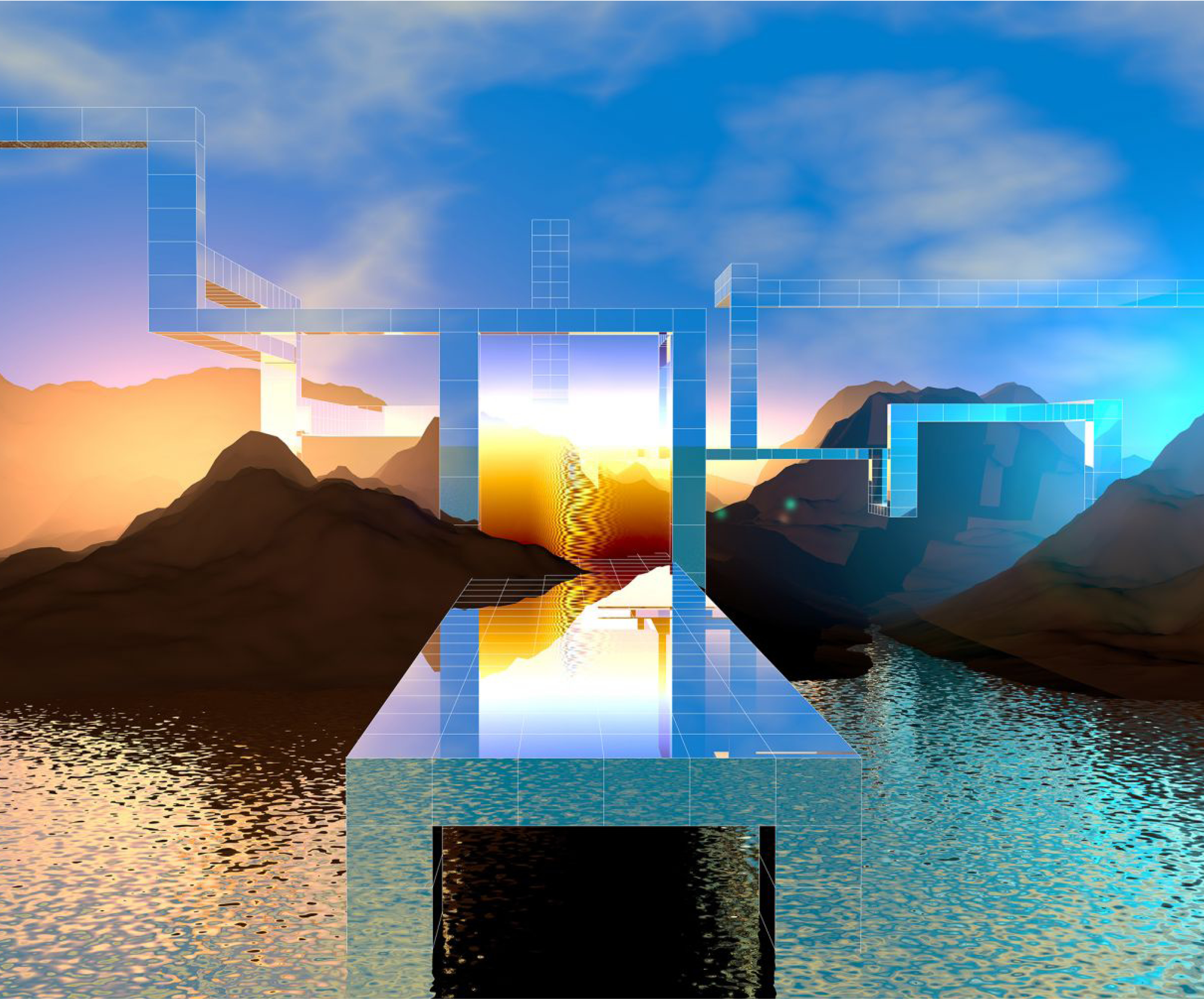
Studying the work of Sabrina Ratté is to glimpse otherworlds, built from elements of our own. To walk through her Cité-jardin is to be both immersed and detached. These portals into impossible places, from the flora and topography of imaginary landscapes to undulating waveforms and strange masses of glitches and plasma, are unreachable and yet the gallery space is transformed. They are manifestly there and yet they are elsewhere. Using video projections and 3D printing, she demonstrates how the virtual world can be increasingly translated into physical states, even if the results are intriguingly ephemeral. Inspired by the ‘Villes nouvelles’ developments around Paris, Ratté’s Machine for Living borrows Le Corbusier’s (in)famous quote from his 1923 book Vers une architecture (“A house is a machine for living in…”). Her creation, with its pseudo-Brutalist steps, has traces of the architect’s work (beginning with his unbuilt but hugely influential Dom-Ino House of 1915), reminding us how strange the designs of this most supposedly-rational of architects actually were. Indeed, Ratté’s Machine for Living echoes back to the unbuilt constructions of the visionary architect Étienne-Louis Boullée (his vast Bibliothèque du Roi of 1785 for instance) or even the illusory labyrinths of Piranesi and Escher, where stairs lead deeper into the maze or back impossibly to where they began. Ratté reminds us that however logical modern architecture has seemed, it all originated in that complex, barely-fathomable and often-illogical place we call, the human imagination.
Undream raises similar questions. A descendant of Superstudio’s technocratic critiques, it adapts their collages of dehumanised man versus nature into something equally startling. Here we get a sense both of the digitised wasteland we might be heading to, or already inhabit, and the fascinating nostalgia that permeates Ratté’s work with her combination of new and outdated technology, as if to say, here is what the future used to be. As with Machine for Living, the viewer might wonder, what is the function of such a space? Why do unbuilt dreams need a function? Is it a dream or nightmare, utopia or dystopia, we are witnessing? And what does that view say about the viewer?
In his Critique of Pure Reason, Immanuel Kant defined our attraction to the Sublime, that feeling of boundless unknowable wonder that we find throughout Ratté’s work, “Whereas the beautiful is limited, the sublime is limitless, so that the mind in the presence of the sublime, attempting to imagine what it cannot, has pain in the failure but pleasure in contemplating the immensity of the attempt.” It used to be a view humanity possessed towards nature and, through it, God. We are told we live in a secular age yet these impulses towards the numinous remain. Attempts to create a sense of the industrial Sublime failed, however many posters were made of booming steel works in the Soviet Union. Today we are told that we are all now in thrall to a technological Sublime, as if Caspar David Friedrich’s Wanderer above the Sea of Fog now looks out over mountains and clouds made of teeming data. In truth, the natural and the technological now exist entwined. We can view an anticyclonic vortex on Jupiter that has been turning since at least the days of the 17th century astronomer Giovanni Cassini. We can gaze into the microscopic and the macroscopic, undertaking atomic-level imaging or constructing an image of a portion of deep space containing 10,000 galaxies, through the devices we’ve created. Our technology helps us understand the dazzling processes of, for example, the murmurations of starlings and in return our understanding of nature provides us with imagery that helps us to incorporate technological developments into our lives (we seem instinctively to be creatures of metaphor and simile – half a dozen languages, for instance, referred to television static as ‘the war of the ants’).
The Sublime is at work in Ratté’s art. It is evident in the aquarium galaxies of Radiances and the captivating iridescent magic-hour landscape of Alpenglow. In the past, architects have sought to create transcendent interiors through the use of light, colour, space and clarity; from Bruno Taut’s iridescent Glass Pavilion (1914) to Mies van der Rohe’s Barcelona Pavilion (1929) to Tadao Ando’s church at Ibaraki (1989). Ratté follows in this tradition but brings an artist’s eye and alchemical almost-holographic technology to bring the outside world inside and have an interior that changes and develops, encouraging contemplation and a genuine sense of awe. It seems profoundly futuristic and yet its source is ancient. It is like the light through a Gothic stained-glass window captured in the clean lines and surfaces of Bauhaus modernism (it should be remembered that the Bauhaus Manifesto of 1919 had a radiating Gothic cathedral on its cover). Perhaps every age has a spirit and Ratté’s tells us something of ours.
There is more to the Sublime than stupefied bliss. At its most moving moments and vistas, it is a combination of awe and fear because at its heart is a sense of the unknown. “It is our ignorance of things” Edmund Burke wrote in A Philosophical Enquiry into the Origin of our Ideas of the Sublime and Beautiful “that causes all our admiration and chiefly excites our passions.” There is always a sense of unease rather than comfort in our acts of gazing into the depths. As a consequence, we are programmed to recognise patterns and chart the unknown, and the perils and opportunities therein, as survival mechanisms. We see objects in clouds, we read auguries in natural events, we used Rorschach inkblots, and we interpret our dreams as ways of trying to know ourselves, each other and the future. The difficulty of placing ourselves has become an obsession. Ratté’s artwork invites and evades speculation. This is, partly, where its power lies. We try to place ourselves within or outside the worlds she creates but they play with the limits of intelligibility and move into other realms. It becomes at times a kind of visual music, in and of itself, belonging to the lineages of artists Ratté has been influenced by (Lillian Schwartz, Toshio Matsumoto, Laurie Spiegel, Eliane Radigue, Doris Norton and so on). Yet they resonate on an emotional level because they are associative as well as disassociative. We see in them not only digitised hallucinations or portents of apocalyptic conditions, like the grey goo of nanotechnology plagues, but the nostalgic childhood hues of Super 8 film and 8-bit graphics and video tape glitches. In doing so, we find fragments of the real in the abstract.
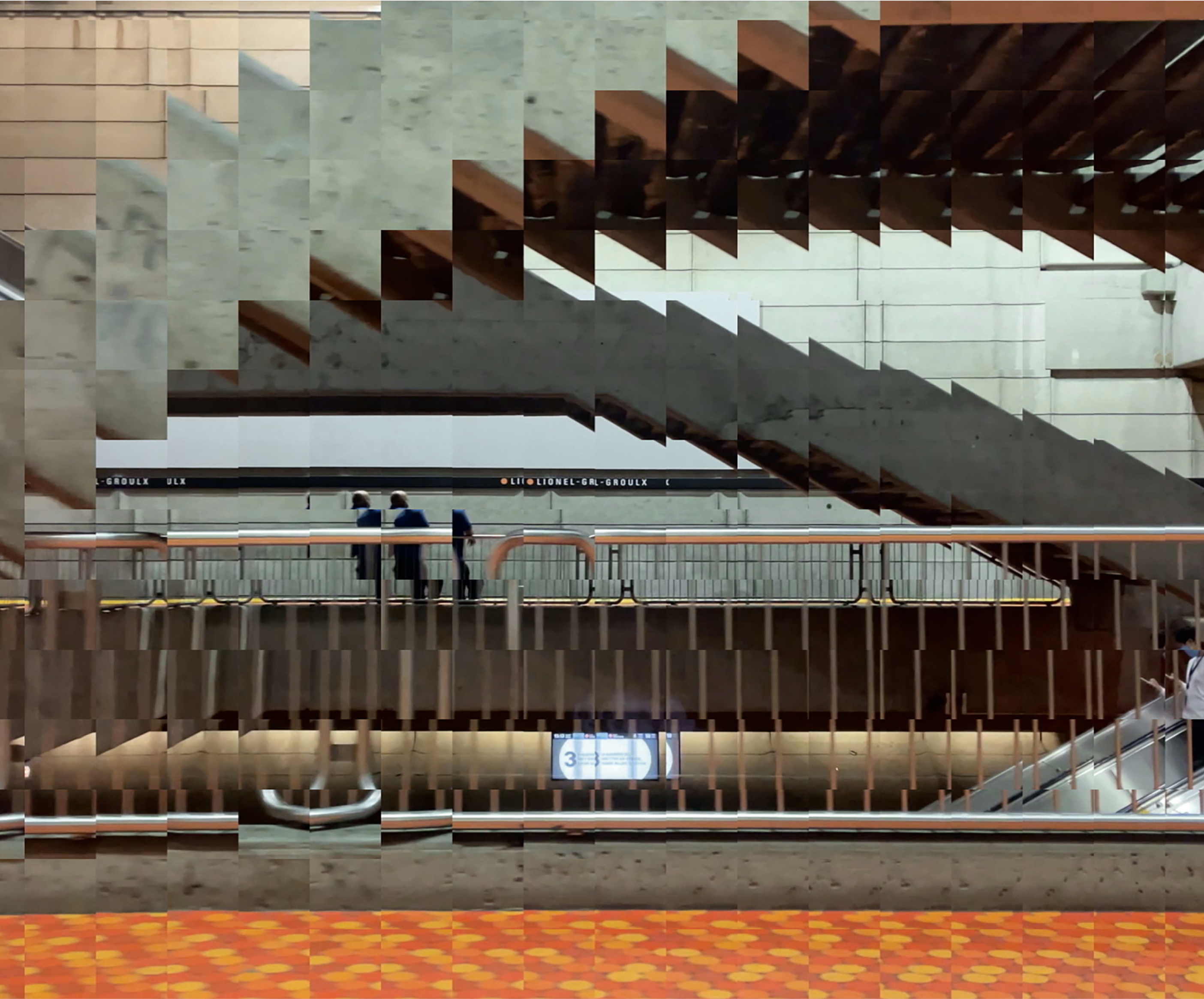
The opposite is also true as Ratté points out. The real, and what we think of as rational and natural, contains the abstract and the surreal. “I think that I am so obsessed these days about ambiances” she reflects “and for me, these ambiances are related to architecture. When I look at buildings, windows, lobbies, streets, they seem abstract to me, and yet, I relate to them so much. It is geometry, shapes, textures, colors, sometimes they seem random, sometimes they please the eye just like a painting would do, and yet, they are so functional and often built in a pragmatic way with no artistic intention. I think I enjoy this ambiguity, being able to recognize shapes, and in the same time realizing how abstract they can be. I am often aiming at creating this effect in my video; a recognizable architecture that would serve no purpose. A corporate lobby is so strange. To me, that's completely abstract!”
In 1927, Marcel Duchamp’s installation The Bride Stripped Bare by her Bachelors, Even (The Large Glass) was being transported from one such place, an art gallery in Brooklyn, when its glass panel was shattered in transit. Far from being devastated, Duchamp declared that his work was finally complete. Chance similarly plays a crucial role in Ratté’s work but her art is continuous, responsive and intuitive rather than completed in any static form. “When I first started working with video, I was using almost only analog technologies such as video feedbacks, and analog video synthesizers to generate images. This approach is magical, as it reacts in real-time to direct manipulation (turning knobs, moving the camera in front of the screen etc), and its beauty lay in the accidents. I felt that I was discovering images rather than creating them. From these beautiful "accidents", a concept for a video emerged, and then I would rationally edit and compose everything from this material.”
The malfunctions, distortions, side-effects and feedbacks that emerge from Ratté’s use of obsolete and experimental technologies require careful, tactile orchestration. There is a sense that she is both painting with light and sculpting with time, to borrow a phrase from one of her influences the director Andrei Tarkovsky (“Solaris has been an explosion in my life. When I saw that movie I felt that the world was complete. It is the perfect film about projection, about how we create our own reality, about how even when we try to transcend our reality by searching other worlds, we just fall back on ourselves”). Here, she underlines how she interacts with chance and the technology she is using in an ongoing journey,
“I am not interested in reproducing a rigid vision… I would say that my videos are the results of a constant dialogue between the limitations of my tools and my vision. The most interesting results seem to happen when an alchemy happens between these fighting elements.”
Ultimately, Ratté’s creations are an invitation into worlds which no two people will perceive in the precisely the same way. The virtual reminds us, after all, that neither the physical or the mental, the objective or the subjective, can lay total claim to the nature of being. “There is an intention to transcend reality with my work, as it is a place where I can be free (or want to be). I want to synthesize and alter abstract feelings that reality (as each of us perceives it) imposes or inspires me to have. My work is not conceptual; I am very intuitive when it comes to creation. The vision I have when I start working on a new piece is not translatable to words. It is like remembering a dream vaguely, just an emotion that remains without the actual story or details. I am looking for ambiances, for ambiguous feelings, subtle tensions between paradoxes, daydream state of mind, out of this world reality I guess. Hopefully and ambitiously, I wish to suggest new shades of light on our sometimes-pragmatic vision of reality. As for my relation with the viewer, it relates also with my relation with reality; I believe that we all project our own vision on people, on our surroundings, on everything we go through based on our personal experiences. I see reality as something we need to define concretely in order to survive, but also as an abstract concept that has the meaning that we are interested to give it, consciously or subconsciously. I guess that's why I am not trying to impose a meaning to the viewer, but I'd rather invite them to visit, to project their own sensibility in the spaces that I am creating.”