Temporality in JJ Levine’s Alone Time
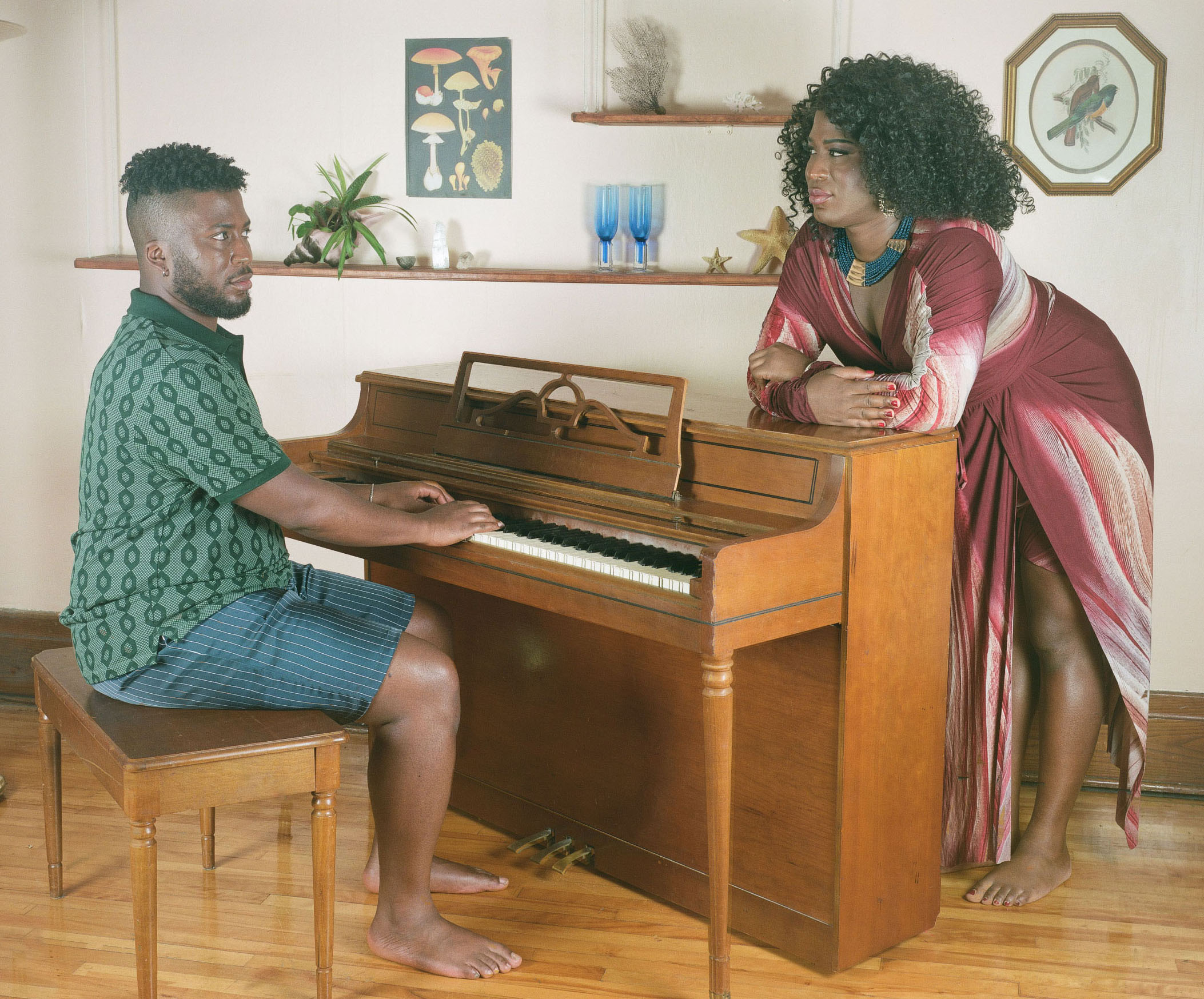
As a series created over nineteen years, JJ Levine’s Alone Time is a body of work with a durational relationship to time. Emerging out of his project Switch, in which pairs of models are presented in prom-style posed portraits, first in one performance of heterosexual presentation and then gender-swapped, Alone Time instead presents a single subject, doubled. Clothing, poses, and hair and makeup styling all conspire to encourage a viewer to read the same human body differently. But in addition to the models and the mises-en-scène that surround them, one of the primary materials of this body of work is, as the title might suggest, time.
The photograph as a form has a troubled yet still arguably indexical relationship to the moment of time it captures; while there is immense manipulation and unreality involved in even the least “touched-up” of images, the medium remains connected to a record of light hitting various surfaces at one specific fraction of a second. But even more so than the single image, the composite photograph creates a moment that never occurred.
The works in this series meticulously layer two slices of time together, allowing them to touch each other.
This kind of compositing, particularly in cinema, is frequently used to depict identical twins (such as Hayley Mills or Lindsay Lohan in The Parent Trap, Jeremy Irons in Dead Ringers, Michael B. Jordan in Sinners), or clones that potentially endlessly replicate an original (as in Teknolust or Mickey 17). But here our doubles are not siblings or copies, but couples: the self as lover. Alone Time 14 depicts this collapse of time to touch the self most literally: the nude subject penetrating their own doubled image. Many of the images contain either physical contact or its implication: the mark of a whip or a tattoo gun, a costumed pregnancy, the handing off of food or drink that will enter the other. Two images interpenetrate, and they are not presented as original and simulation, or past and future, but as companions, as peers, as two simultaneous presences that have chosen to come together. One response to the images of Alone Time might be to try and guess at the “real” gender presentation of the subject. This game is perhaps both encouraged by and rendered fruitless by the work’s playful refusal to be legible, to be documentary. A cosmetic mustache may be more or less convincingly homegrown in one image over another, but this tells us nothing of the subject’s relationship to it. We are given only two figures in each other’s company, both holding myriad possibilities for truth or fiction.
The series concludes with a moving-image work, a medium that has been a part of Levine’s practice for about a decade, but had not had a role in this series until this final piece. Levine’s other moving-image works frequently portray parents and children, drawing on his own experience of parenthood, and of society’s aggressive gendering of both parents and children. Friends with Children Dancing (2018) and Sea of Love (2016) present intimate, joyous portraits of parents and children in domestic spaces; I want you (2023) emphasizes intergenerational contact, as a child presses hands against a pregnant belly. The photograph Alone Time 19 features the signature doubling of the subject found in this series, but is the only work to feature two doubled models: an adult and a child, creating a non-existent family portrait of mother and son, father and daughter, that calls up the heteronormative portrait modes critiqued in Levine’s photo series Switch and its prom-styled couples.
In his acerbic writing on “reproductive futurism”1, literary critic Lee Edelman asserts that an oppressive society weaponizes an abstract idea of “the Child” — a hypothetical concern not tied to the wellbeing of any actual individual children — to control behavior, to determine what narratives of the future are perceived as possible. His cynical, provocative book No Future has received many critiques, additions, and reworkings, including thoughtful considerations of the relationship between queerness and time by José Esteban Muñoz and Jack Halberstam. Intersectional feminist scholar Sara Ahmed has written extensively on “orientation” as a concept that is both spatial and temporal.2 What do we face toward or away from as queer people? What “straight line” do we not move smoothly along through time? All this context swirls around me as I look at the layered time of Levine’s photographs.
Trans and gender non-conforming relationships to temporality contain unique qualities: Jay Prosser and Paul B. Preciado have offered strident critiques of the linear narratives of time and gender that trans people are often forced to perform to receive essential care. (Preciado writes: “I had to declare myself insane. […] I had to declare that my mind was at war with my body, that the mind was male and the body was female.”3) Philosopher Megan Burke describes misgendering as a form of “temporal capture”4 that attempts to force the past into the lived experience of the present. In Time Binds: Queer Temporalities, Queer Histories, Elizabeth Freeman examines “chrononormativity” as how “naked flesh is bound into socially meaningful embodiment through temporal regulation.”5 Institutional structures and narratives of time arrange our bodily lives according to their schema, including cisheterosexuality, and then make these constructions appear “natural.” Image production, such as the histories of portrait photography that Levine toys with so precisely across numerous works, is often enlisted into the projects of chrononormativity.
What then might alternate conceptions of time look like? How might we resist an idea of gender as either fixed at birth, or requiring a clean and total narrative break from the past? What is the role of simultaneity, rather than linearity, in creating a more inclusive vision of both the present and the future? How might we reach out and touch ourselves in another moment in time?
By bringing Alone Time into a more explicitly “time-based” medium for its finale, Levine foregrounds the element of time-as-material found throughout the series, but also allows for the introduction of music. Levine’s previous films make frequent use of non-diegetic music, forgoing synchronized sound and accompanying the documentation of their subjects with a song that floats above the scene, typically a new performance of a pre-existing composition. In Alone Time Finale, the video installation that completes the series, Levine collaborates with musician J3M. J3M diegetically performs an original song within the two-channel video piece, with first one and then two iterations of J3M singing. The initial duet might bring to mind Shirin Neshat’s 1998 video installation Turbulent, which features projections of a male and female vocalist placed opposite each other. In Neshat’s piece, their separation and contrasting, alternating performances powerfully illustrate her critique of gender oppression in 1990s Iran. In Alone Time Finale, a substantial formal difference emerges from the specific political context that spurs on this work: about halfway through the film, the femme J3M exits the projection, only to enter the other frame. The two figures continue their duet, grouped around the piano as the other projection continues to show an empty room. The lyrics may imply a distinctly linear, forward-moving relationship to time: “no turning back / no matter what they say / I’m not sorry / won’t apologize / I’m doing things my way / I’m not – / won’t let you put me down / come too far to give up now,” and later, “my future’s looking bright.” But the blending of two different iterations of the same voice, the blending of composite footage of two different iterations of the same performer, invites a more expansive experience of temporality. As one J3M sings to the other as they are about to share the same frame, “come on out, we’re one and the same.” Perhaps rather than engaging with the works of Alone Time as a guessing game about the “true” self, we can take them as an invitation to walk out of the frame to join ourselves.
Notes
1 Edelman, Lee. No Future: Queer Theory and the Death Drive. Duke University Press, 2004.
2 Ahmed, Sara. Queer Phenomenology: Orientations, Objects, Others. Duke University Press, 2006.
3 Preciado, Paul B. Dysphoria Mundi: A Diary of Planetary Transition. Graywolf Press, 2025, p. 7
4 Burke, Megan. “Misgendering as Temporal Capture.” Trans Philosophy, 2024.
5 Freeman, Elizabeth. Time Binds: Queer Temporalities, Queer Histories. Duke University Press, 2010, p. 3 (I would like to thank Professor Cáel M. Keegan for introducing me to much of the work cited here.).